This post contains affiliate links, and I may earn a small commission if you make a purchase through them. These earnings help me maintain this website and continue creating more helpful content. Thank you for supporting my work. ❤️
Vietnamese wigs and hair extensions have gained attention for their smooth texture, straight finish and premium reputation. But “Vietnamese hair” and “Vietnamese processing” are not automatic guarantees of quality.
Here is what wig buyers and small hair businesses should know before placing an order.
What Is Vietnamese Wig Processing?
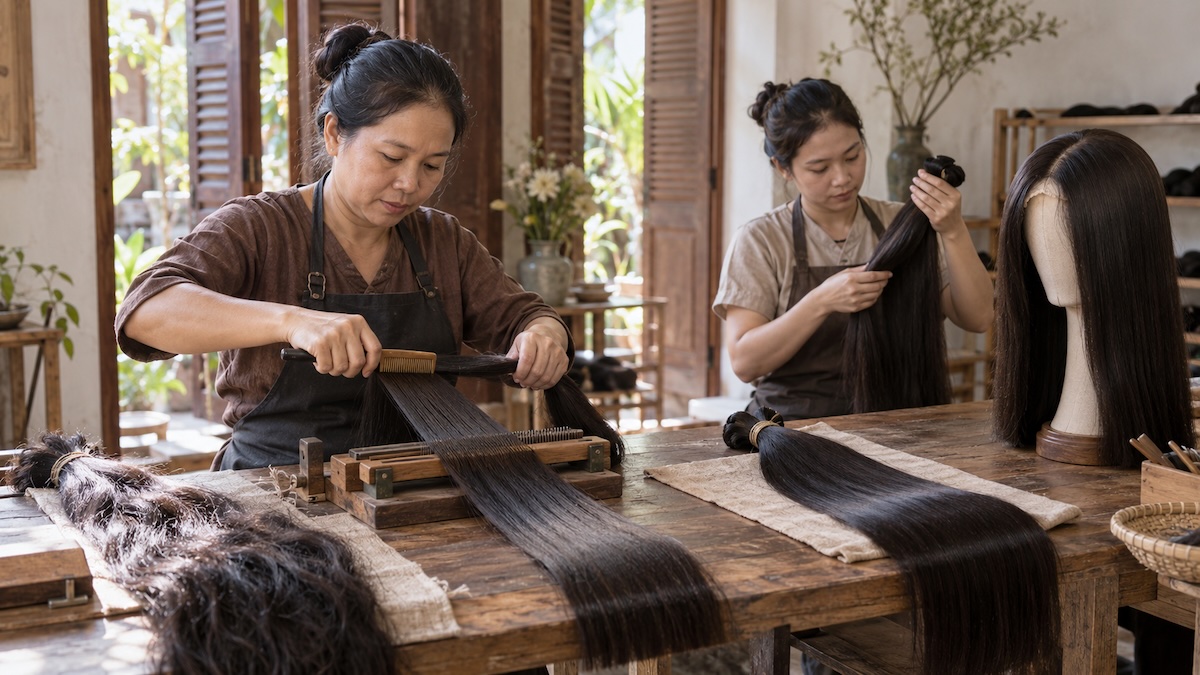
One feature associated with Vietnamese processing is intensive hand straightening. Workers repeatedly pull and straighten the hair using specialised tools until it becomes extremely straight, smooth and free from visible frizz.
Compared with fast, large-scale processing, this method requires more manual work. When good raw hair and skilled workmanship are combined, the finished hair can feel exceptionally sleek and polished.
However, the process cannot turn poor raw hair into a genuinely premium product. Final quality still depends on:
The grade and condition of the raw hair
Whether the cuticles remain intact and aligned
Previous chemical treatment
The skill of the worker
The consistency of quality control
Smell Does Not Prove the Hair Is Vietnamese
Some customers smell the hair to decide whether it was processed in Vietnam. This is unreliable.
A recognisable fragrance may come from oils, shampoo, conditioner or perfume used during production. Similar scents can be added by factories in other countries.
Smell cannot confirm:
Where the hair was collected
Where it was processed
Whether it is virgin or Remy hair
Whether it has been acid-treated
How it will perform after washing
Buyers should judge the hair after washing and wearing it, not by fragrance alone.
Why Quality Can Vary
“Vietnamese hair” may refer to the origin of the raw hair, the processing location or simply a marketing description. These are not the same thing.
Two products carrying the same label can perform very differently. One may use carefully selected hair and detailed hand processing, while another may use lower-grade hair finished with silicone and fragrance to create a convincing first impression.
Before buying, check for:
Tangling after washing
Excessive shedding
Dry or rough ends
Short hairs mixed into the length
Changes after the coating washes away
Inconsistent colour, density or texture
A soft first touch is not enough. The real test begins after several washes.
Premium Quality Often Means Slower Production
Labour-intensive processing is difficult to scale quickly. This can make Vietnamese-style production suitable for small, high-value orders but less dependable for large-volume orders with tight deadlines.
It may work well for:
High-end custom wigs
Premium hair extensions
Small luxury collections
Special textures or lengths
Detailed lace products
It may be less suitable for:
Large wholesale orders
Fast restocking
Trend-driven products
Orders with fixed launch dates
Businesses promising very short delivery times
Lower labour costs do not necessarily produce faster or cheaper orders. Production speed, consistency and communication must also be considered.
What Small Wig Businesses Should Do
Never place a large order based on one impressive sample.
Start with a small test order and examine:
Quality consistency across several units
Hair condition after multiple washes
Shedding, tangling and heat performance
Accuracy of length, weight and density
Production time and shipping reliability
The supplier’s response when problems occur
Ask the supplier to explain exactly what “Vietnamese” means in its product description. Is the hair collected in Vietnam, processed there or only made with a Vietnamese-style finishing method?
These details should appear in the purchase agreement whenever possible.
The Bottom Line
Vietnamese processing can produce beautifully straight, smooth hair, especially when skilled handwork is combined with good raw material. Its strengths are finish and craftsmanship—not speed or mass production.
For buyers, do not use smell or marketing labels as proof of quality. Test how the hair performs after washing.
For small businesses, Vietnamese-made products may be better suited to a premium collection than to fast-moving bulk inventory. Order small, test carefully and confirm realistic production times before scaling.