This post contains affiliate links, and I may earn a small commission if you make a purchase through them. These earnings help me maintain this website and continue creating more helpful content. Thank you for supporting my work. ❤️
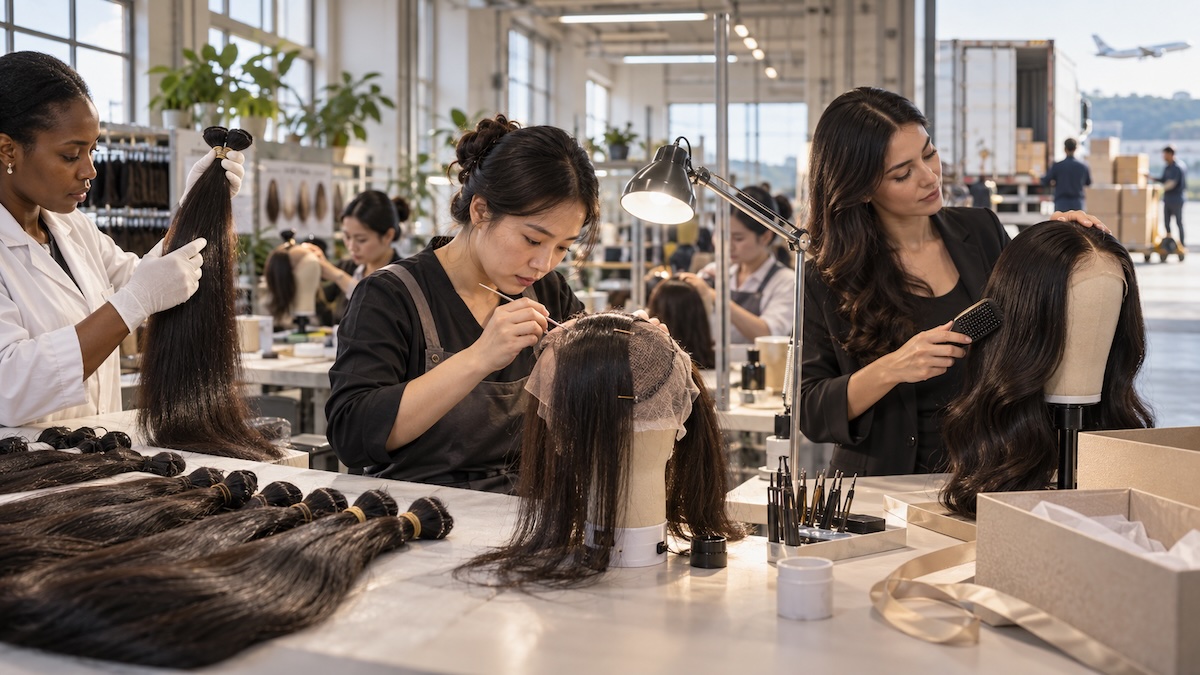
A wig may be made in China, use human hair collected in India and be sold by a brand in the United States. Understanding this supply chain can help wig buyers choose better products and help small wig businesses avoid costly sourcing mistakes.
1. Hair Type Matters More Than “100% Human Hair”
Human hair varies greatly in quality.
Premium hair usually has:
Cuticles intact and facing the same direction
Minimal chemical processing
Consistent length
Less short hair mixed into the bundle
Lower-grade hair may contain fallen hair, mixed cuticle directions or heavily acid-treated strands. It can still be labelled “100% human hair,” but it is more likely to tangle, shed or become dry after several washes.
For buyers, “human hair” alone is not enough. Ask whether the hair is Remy, virgin, chemically processed or mixed with shorter strands.
For sellers, test hair after repeated washing, brushing and heat styling—not just when the sample first arrives.
2. The Most Expensive Part May Be the Handwork
A machine-made weft can be produced within a few hours. A full lace wig may require 60–80 hours of hand-knotting, and high-density units can take even longer.
This explains why two wigs made with similar hair can have very different prices. Construction affects:
Hairline appearance
Parting space
Knot size
Comfort and breathability
Shedding resistance
Overall durability
A higher price does not always mean better hair. Sometimes customers are paying for more detailed ventilation, a better cap and longer production time.
3. Glueless Wigs Are Reducing the Installation Barrier
Glueless wigs have become popular because they remove several common difficulties:
No adhesive is required
Installation takes less time
Beginners can wear them more easily
The wig can be removed daily
There is less risk of glue-related irritation
Pre-cut lace, pre-plucked hairlines, adjustable bands and ready-to-wear caps all follow the same trend: moving part of the installation work from the customer to the factory.
For small sellers, convenience may be a stronger selling point than density or length. A product that saves the customer 30 minutes can be easier to market than one that simply claims to use “better hair.”
4. Factory Price and Retail Price Are Not the Same Thing
Xuchang, China, produces a large share of the world’s wigs, but many local factories work as OEM suppliers with relatively low margins. Overseas brands can charge much more because they control:
Customer data
Product positioning
Content and advertising
Packaging
Returns and after-sales service
Repeat purchases
This means a low factory price is not automatically suspicious, and a high retail price does not automatically guarantee superior quality.
Buyers should focus on verified product performance and return protection. Small sellers should understand that the largest margins usually come from customer trust—not simply from finding the cheapest factory.
5. Small Sellers Should Test Before Ordering in Bulk
Before placing a large order, test several samples for:
Shedding
Tangling
Odour
True length and density
Lace colour and thickness
Knot size
Cap fit
Heat resistance
Hair condition after washing
Consistency between samples
Wear testing is especially important. Many defects do not appear in product photos or during the first unboxing. They become visible only after several days of use.
Do not rely entirely on a supplier’s terms such as “virgin,” “raw,” “HD lace” or “unprocessed.” Request clear specifications and confirm them through testing.
6. Choose the Sales Channel Carefully
Small wig businesses can sell through Amazon, AliExpress, TikTok Shop or an independent website.
Marketplaces offer traffic and buyer protection, but they also charge fees and control store rules. Independent websites provide more control over branding and customer information, but require businesses to generate their own traffic.
A practical approach is:
Test products with short videos and small orders.
Identify the styles that receive real customer interest.
Collect feedback about fit, lace, shedding and installation.
Restock only the products that perform consistently.
Build an independent website after confirming demand.
Do not invest heavily in livestreaming before finding a product that already performs well in short-form video.
7. Different Customers Value Different Things
The same wig can be positioned very differently:
Black and African diaspora customers may prioritise protective styling, natural textures and easy installation.
Fashion customers may prioritise colour, trend and affordability.
Customers experiencing hair loss may care most about comfort, realism and security.
Male hair-system customers often prioritise an undetectable result.
Older customers may prefer easy maintenance and in-person fitting.
A successful wig business does not try to sell every product to everyone. It identifies one customer group and solves that group’s most important problem.
Final Takeaway
The wig business is no longer only about buying hair cheaply and selling it at a higher price. Product construction, convenience, quality control and customer trust now create much of the value.
For buyers, the safest choice is a well-tested product sold with clear specifications and reliable after-sales protection.
For small sellers, the opportunity lies in understanding what happens after the wig is worn—not simply how it looks in a product photo.