This post contains affiliate links, and I may earn a small commission if you make a purchase through them. These earnings help me maintain this website and continue creating more helpful content. Thank you for supporting my work. ❤️
Vietnam has lower labour costs, while India has abundant raw materials. Could either country eventually replace China as the centre of the global wig industry?
Both Vietnam and India may have strong opportunities in the medium to long term. In the short term, however, neither is capable of replacing China.
Vietnam has already developed two wig-manufacturing clusters in Bac Ninh. Its production techniques are more mature than India’s, and Vietnamese hair products have gained a certain level of international recognition. India, meanwhile, benefits from its enormous supply of raw human hair and relatively high production efficiency.
However, there is still a generation’s worth of industrial development between having potential and becoming the next China.
Vietnam: Mature Craftsmanship, but Low Efficiency
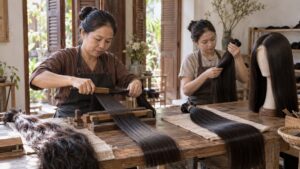
Vietnam’s wig industry has developed from simply collecting human hair into a manufacturing sector capable of producing mid-range and high-end customised hair products. Its main production areas are concentrated in the southern industrial belt formed by Ho Chi Minh City, Binh Duong Province and Dong Nai Province.
From 2023 to 2025, Vietnam’s hair-product exports grew at an average annual rate of 18.7%, far above the global average. Synthetic hair products accounted for more than 65% of exports, while human hair products became the main driver of profit growth.
However, Vietnam still faces two major obstacles.
The first is production efficiency.
The output of a Vietnamese worker is only about 60% to 70% of that of a Chinese worker in the same position. A factory may pay around 80% of Chinese wage levels but receive only slightly more than 60% of the productivity. As a result, the labour cost per product may actually increase rather than decrease.
Overtime is also less common in Vietnam. Although automation in the production process has exceeded 40%, colouring and dyeing still rely heavily on manual labour. A shortage of skilled workers has kept capacity utilisation below 80%.
The second obstacle is the supply chain.
Vietnam’s domestic raw-material supply can meet only 58% of its demand. China remains Vietnam’s largest source of imported human hair materials, accounting for 63% of the total.
In simple terms, Vietnamese wig factories still need to purchase a large share of their raw materials from China.
Vietnam’s manufacturing techniques are certainly improving. The natural appearance of its products has reportedly reached more than 85%, and some leading manufacturers are even benchmarking their products against high-end Korean brands.
However, unless Vietnam improves production efficiency and strengthens its supply chain, “Made in Vietnam” will continue to fall short of becoming a complete alternative to Chinese manufacturing.
India: Abundant Raw Materials, but a Difficult Business Environment
India’s situation is almost the opposite of Vietnam’s.
India does not lack raw materials. Hair donations at Indian temples provide an enormous supply of human hair. The government has even set a purchase price of 5,500 rupees, or approximately US$65, per kilogram for certain types of hair.
Many well-known human hair extensions sold on the international market originate in India.
In theory, India should be the country with the greatest potential to replace China. It has workers, raw materials and a large domestic market.
In reality, however, anyone planning to establish a factory in India must first find a reliable local partner who can manage the country’s complicated social and business relationships.
India’s overall business environment is more challenging than Vietnam’s, and its living conditions can also be more difficult for foreign investors and managers.
Its infrastructure, electricity supply and logistics efficiency remain far behind China’s. These weaknesses become even more serious in an industry such as wig manufacturing, which depends heavily on a stable and responsive supply chain.
Which Country Is Closer to Becoming the “Next China”?
If Vietnam and India must be compared, Vietnam is currently ahead in manufacturing techniques and industry maturity.
Vietnam has built a relatively complete production chain covering raw-material collection, processing and mid-range to high-end customisation. The two wig-manufacturing villages in Bac Ninh have become important sourcing destinations for international buyers. In 2025, Vietnam’s wig exports reportedly grew by as much as 15%.
The disadvantages, however, are equally clear.
Manufacturers may pay approximately 80% of Chinese wage levels while receiving only 60% to 70% of Chinese productivity. Limited overtime and an underdeveloped supply chain can extend delivery times by 15 to 20 days compared with China.
India has abundant raw materials, a large market and lower labour costs. Its workers may also be more productive than those in Vietnam.
For a Chinese manufacturer entering India, however, finding a local partner capable of handling local business and social relationships is often the first major challenge. India’s business and living environments are generally more difficult than Vietnam’s, while weaknesses in infrastructure, electricity and logistics make many potential investors hesitant to establish factories there.
Xuchang’s Real Competitive Advantage Is Not Cheap Labour
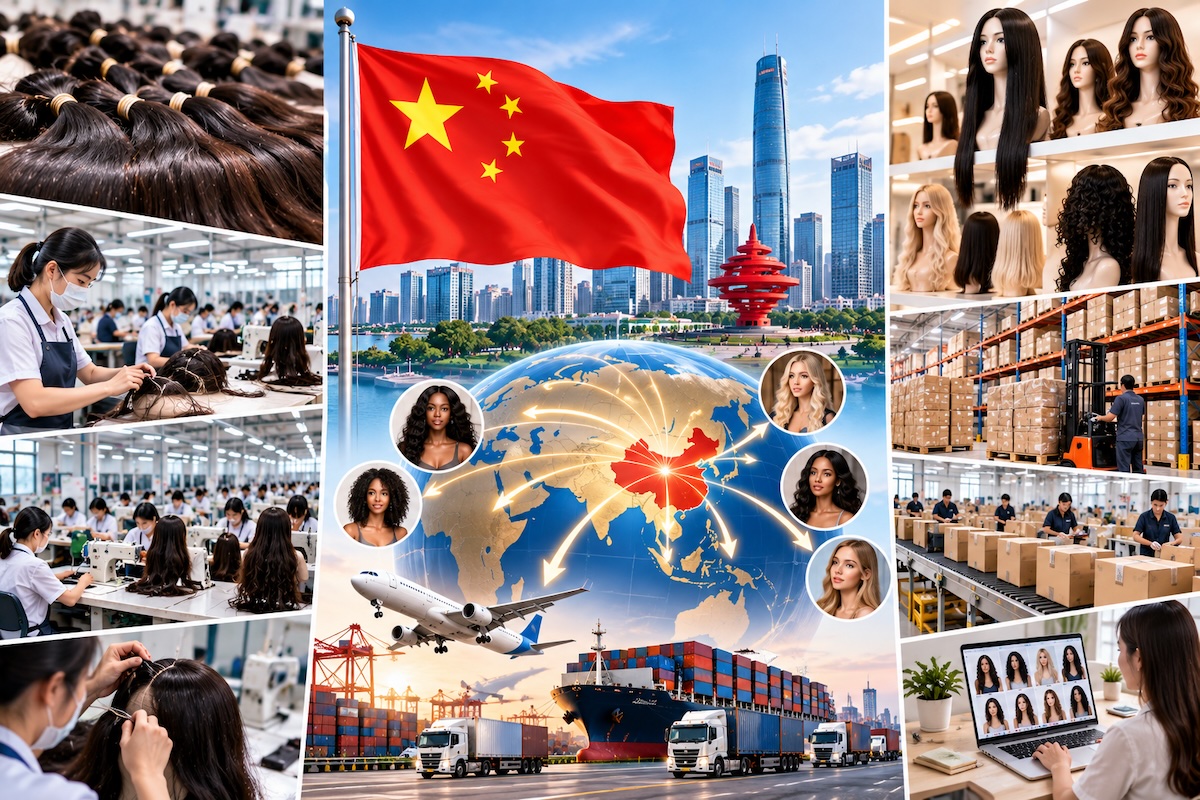
Six out of every ten wigs sold worldwide are produced in Xuchang, China. In 2025, the city’s wig exports reached 17.2 billion yuan, and Xuchang was home to more than 2,000 manufacturers.
Behind these figures is a complete industrial ecosystem that has taken decades to build. Raw-material sourcing, processing, manufacturing, logistics and cross-border e-commerce can all be completed within the same city.
Vietnam and India currently possess only certain parts of this manufacturing capability. Xuchang, by contrast, has an entire ecosystem.
For Vietnam to replace Xuchang, it would need to improve production efficiency, expand supply-chain capacity and establish a complete industrial network. Each of these tasks could take more than ten years.
Vietnam and India are both emerging forces that deserve close attention from the global wig industry. But in the foreseeable future, neither country is likely to replace China as the world’s leading wig-manufacturing hub.